
Sponsored by:

My Plea:
SUE DALE
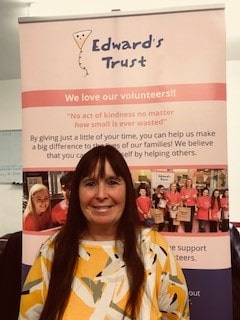
My name is Sue Dale and I am proud to be a Children’s/Young Person’s Counsellor for Edward’s Trust a Children’s and Families Bereavement Charity based in Edgbaston, Birmingham.
I am married with 2 grown up children and 5 grandchildren.
I would like to thank Louise Wright for nominating me for this award in memory of her baby son Billy.
I have been a full time bereavement counsellor for 13 years and on average see 25 young people each week ranging in age from 4 to young adult. We offer a holistic approach to our counselling with no limitation on the number of sessions. It is very much about the individual’s needs and the needs of other family members supporting them.
WHAT I DO
The aim of counselling is provide a warm, non-judgemental and trusting environment in which the client feels valued and listened too. Under the right conditions the young person’s potential for ongoing growth and development naturally unfolds.
The children’s team work with a wide variety of cases including Murder and Suicide, children present with a wide spectrum of additional concerns including self harm, anxiety, eating disorders, anger and special needs including ADHD and ASD. Often the family dynamics have broken down and communication is difficult. The basis of my counselling work is to provide a warm and trusting environment in which the child feels safe and listened too, to provide a relationship in which the child feels that over time they can express their feelings and be able to look forward to and take part in life again.
HOW I WORK
I would describe myself as a Person-Centred Integrative Counsellor which means that my core theoretical model is Person-Centred which emphasises a person’s natural capacity to develop in a positive way if the right conditions for growth are provided. I have a Degree in Counselling and a Foundation Degree in Integrative Counselling and 13 years’ experience of working with Children & Young People.
The Person-centred model believes that each human being has the potential for creativity, love, growth and psychological health and that ‘the relationship is the therapy’ (Mearns & Thorne 2000) being that the quality of the relationship between Counsellor and Client lies at the heart of the effectiveness of the counselling process.
Building on this Person-Centred framework the integration of techniques from other models is used to enhance the effectiveness of the counselling relationship. An Integrative Counsellor can work with each client to produce a unique therapy adapted to too suit the client’s individual needs. For example a child whose grief has led to them becoming anxious about the world around them to the point of being psychically sick and not being able to regularly attend school would need the warm and non-judgmental space to be able to express how they feel but also some CBT techniques to be able to manage their anxiety. This could take the form of a piece of artwork in the form of personal visualization of things and places that make the child feel safe and in turn reduce their feelings of anxiety. A second example would be a teenager who through her pain of grief cuts her arm. In this instance the framework would be Person-Centred and CBT techniques could be used in the form of a journal or diary charting the young person’s routine of self harming and negative thought patterns leading to more positive coping mechanisms.
Click here to see examples of how we use art in Art in Children’s therapy – The Use of Art in Children
OUR RESULTS
I work with the children in a very creative way which can provide for example the artwork a very visual expression of feelings. Movement and growth can visibly be seen in each piece
At present I am working with the teenagers on Vision Boards which are examples of where they are in their lives, good and positive examples of what is good their lives, positive role models, supportive family and ideas of future. This work gives them hope and inspires them to grow.
Results can be seen in feedback from schools and families, a child’s attendance may have improved or they may have become happier and more responsive in group environments. Communication with families and friends has become easier and the child becomes happier and more open to growth.
Following are some feedback from cards that I have received following the young person’s ending with Edwards Trust:-
‘Thank you for everything you have done for me, if it wasn’t for you I wouldn’t be this far right now’
‘Thank you for making me and my mum happy again’
‘You have helped me so much; I will always remember my special place and special memories’
‘I used to cry when I thought of my Grandad but now you’ve taught me to smile when I think of him’
‘Thank you for giving me my daughter back’
‘Just to say thanks so much for all the help you have given the children and supporting us as a family’
‘Without your help and support I don’t know where we would be’
‘Thank you for helping me smile again’.
‘Thank you for getting me through this sadness’.
What Others Have Said
“I first spoke to her the day after I lost my 12 day old son Billy , I was in a real state of acute grief and seeking help for my surviving 10 year old son . Sue was a calm voice at the end of the phone who helped and guided me through those first initial few days. My son attends weekly counselling sessions – when he began them he was a scared, lost and angry little boy. With Sue’s help he is able to talk and remember his little brother fondly and is able to cope with his grief.”
https://www.youtube.com/watch?v=Kxao0EpuV68
Sue worked with my son when his nephew passed away.
She was an absolute godsend.
it has been six years since his last session and he still talks about her now.
She had a massive impact in helping him to cope with his bereavement.
Hi Joanne,
Thank you for your lovely words. I remember you both fondly. Best wishes Sue
Truely inspirational lady who should be recognised for her great work
Hi Kerry
Thank you so much for your kind words. Best wishes Sue
My husband and i met Sue at Edwards House 15 years ago when our angel Tia Rose was undergoing heart treatment at BCH. We will never forget her support whilst Tia was alive and after. Thank you Sue xx
Hi Michelle
I remember you too and our time together. With love and best wishes
Sue x
Absolutely incredible and fully deserved on your nomination. The commitment to those in need at such a difficult time in their life is amazing, well done Sue keep up the great work I know James will be very proud of you.
Thank you so much Matt for your kind words and vote.
Best wishes Sue
Inspirational
Thank you Mark for your kind words and vote.
Hey big sister, we are all very proud of you!
You’re doing an amazing job !
M.
Thank you little bro. ? x